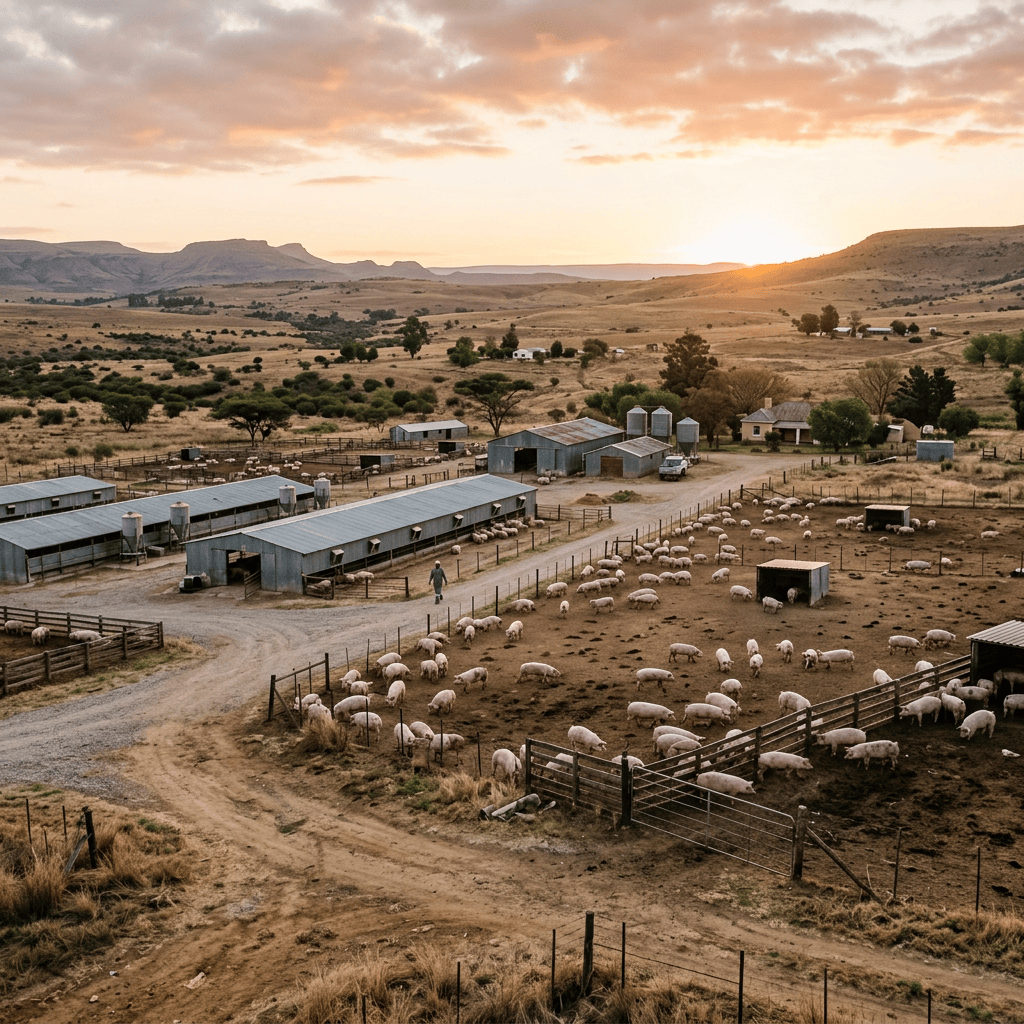
Starting a pig farm in South Africa requires four core things: a registered piece of land that meets local zoning rules, a permit from your provincial Department of Agriculture, starter stock of a suitable breed, and enough working capital to cover feed for the first four to six months before you sell your first pigs. Below is the full process, broken into the order you’ll actually need to tackle it.
Pig farming remains one of the more accessible livestock businesses to break into in South Africa, because pigs reproduce quickly, convert feed to meat efficiently, and don’t require the grazing land that cattle or sheep do. But “accessible” doesn’t mean effortless, most new piggeries fail in the first 18 months because of underestimated feed costs or poor disease control, not because pork demand is weak.
Step 1: Understand the Legal and Zoning Requirements
Before you buy a single pig, confirm the following:
Zoning: Your land must be zoned for agricultural use. Residential and smallholding erven often have restrictions on livestock numbers, check with your local municipality.
Registration with the Department of Agriculture, Land Reform and Rural Development (DALRRD): Commercial piggeries need to register their premises, largely for disease traceability (African Swine Fever monitoring in particular).
Environmental compliance: If you plan to run more than a small hobby herd, you may need a waste management plan for manure and slaughter by-products, especially if you’re near a water source.
Movement permits: Moving pigs between provinces requires a permit, and pigs from areas with reported Swine Fever outbreaks may face restrictions.
Skipping this step is the single biggest reason hobbyist piggeries get shut down or fined once they scale up.
Step 2: Choose Your Farming Model
There are three common entry points in South Africa:
1. Backyard/smallholding piggery (5–20 sows): Lowest capital requirement, sold mostly to local butchers, informal markets, and direct-to-consumer.
2. Semi-commercial farrow-to-finish (20–100 sows): You breed, raise, and sell pigs at market weight (typically 90–100kg). Requires more infrastructure but better margins per pig.
3. Contract/finishing farming: You buy weaners from an established breeder and raise them to slaughter weight only. Lower risk, since you skip the breeding and farrowing stage, but margins are thinner.
Most first-time farmers in South Africa start with option 1 or 3, since they require less specialised infrastructure (like farrowing crates) and less capital tied up in breeding stock.
Step 3: Budget for Startup Costs
| Rough estimates for a small 10-sow backyard operation (2026 pricing, subject to regional variation): Item | Estimated Cost (ZAR) |
| Land preparation & fencing | R15,000 – R40,000 |
| Basic housing/pig sties (10 sows + boar) | R30,000 – R80,000 |
| Starter breeding stock (8 sows + 1 boar) | R25,000 – R45,000 |
| Feed (first 4 months, before income) | R20,000 – R35,000 |
| Water infrastructure | R5,000 – R15,000 |
| Veterinary/vaccination costs | R3,000 – R8,000 |
| Total starting capital | R98,000 – R223,000 |
Step 5: Choose Your Breed
For South African conditions, common starter breeds include Large White, Landrace, and Duroc, or crosses between them. (See our companion guide on the best pig breeds for small-scale farms in South Africa for a full comparison of growth rate, hardiness, and litter size.)
Step 6: Source Healthy Starter Stock
Buy from a registered breeder, not an informal seller with no health records. Ask for:
- Vaccination history
- Proof the herd of origin has no recent disease outbreaks
- Weaning weight and age records
A slightly higher upfront price for verified healthy stock is almost always cheaper than the losses from introducing disease into a new herd.
Step 7: Plan Your Feeding Programme
Pigs need a feed ratio that shifts with age:
- Weaners (8–10 weeks): High-protein starter feed (~18–20% protein)
- Growers (10–20 weeks): Grower feed (~16% protein)
- Finishers (20 weeks to slaughter): Finisher feed (~14% protein), often supplemented with cheaper bulk feed sources
Many small-scale South African farmers reduce costs by supplementing commercial feed with kitchen scraps, brewer’s grain, or maize by-products — but this needs careful balancing to avoid nutrient deficiencies. (Our feeding-on-a-budget guide covers this in detail.)
Step 8: Build a Disease Prevention Plan
At minimum:
- Quarantine any new animals for at least 2–3 weeks before introducing them to the herd
- Keep visitor and vehicle access to a minimum
- Maintain a vaccination schedule with your local vet (typically covering erysipelas, parvovirus, and leptospirosis)
- Watch for signs of African Swine Fever — high fever, loss of appetite, red/purple skin discolouration — and report suspected cases to DALRRD immediately, as it’s a controlled disease in South Africa
Step 9: Plan Your Market Before You Have Pigs to Sell
Line up buyers before your first litter reaches market weight:
- Local butchers and informal traders (fastest, most flexible)
- Abattoirs (requires more paperwork but better for consistent volume)
- Direct-to-consumer sales (highest margin, most time-intensive)
Most successful small farms use a mix, informal sales for quick cash flow, and a standing relationship with one abattoir or butcher for predictable volume.
How Long Until You See a Return?
A sow typically produces her first litter around 10–12 months after you start (accounting for growth to breeding age, gestation of ~114 days, and weaning). From there, most farmers budget 5–6 months to raise a weaner to market weight. Realistically, plan for 12–18 months before the farm is cash-flow positive.
FAQ
How much land do I need to start a pig farm in South Africa? A small 10-sow operation can run on as little as 0.5–1 hectare, provided housing, waste management, and buffer zones from neighbours are properly planned.
Do I need a permit to keep pigs in South Africa? Yes. Commercial and semi-commercial piggeries must register with the Department of Agriculture, Land Reform and Rural Development, largely for African Swine Fever traceability. Check municipal zoning rules as well, since these vary by area.
How much capital do I need to start a small pig farm? Budget roughly R100,000–R220,000 for a starter 10-sow operation, covering land prep, housing, breeding stock, and four to six months of feed before you have income.
Is pig farming profitable in South Africa? It can be, with typical net margins in the 15–25% range for well-managed small operations, but feed costs (60–70% of expenses) and disease control are the two biggest factors determining profitability.
What is the fastest way to start pig farming with less capital? Contract finishing — buying weaners from an established breeder and raising them only to slaughter weight — requires less upfront capital than a full farrow-to-finish operation, since you skip breeding stock and farrowing infrastructure


Leave a Reply